Explore a library of messages, ideas, and stories written into Ethereum's history.
LOOKING FOR SOMETHING SPECIFIC?
Exact text search or a complete Ethereum wallet address.
ECAT / ABOUT / READING ROOM
Two essays on the archive, its earliest cat, and the human history preserved in Ethereum transactions.
ECAT / ESSAY 001
THE CONSCIOUSNESS OF ETHEREUM
Ethereum is usually described through the things it makes possible: payments, contracts, markets, organisations and digital property. These are substantial achievements, and they have produced cultures of their own. Artists, collectors, developers and communities have already made the network a place of public expression. But there is another kind of cultural record inside Ethereum, one that was rarely presented as culture when it was made. It consists of messages placed in transactions, often without an audience in mind and sometimes without any reason beyond the desire to leave a few words somewhere permanent.
A blockchain records actions in a particular order. Its structure gives those actions a date, an address and a place among millions of others. A sentence written into a transaction is therefore different from a sentence in a notebook or a post on a website. It belongs to a ledger built for verification rather than remembrance. The network does not distinguish a declaration of love from a joke, an experiment or a fragment of poetry; it records the data according to the same rules. Meaning arrives later, when someone chooses to read it.
This distinction matters when we speak of Ethereum's consciousness. The phrase does not suggest that the network is alive or capable of thought. It describes something collective: the accumulated traces of people using a shared system across time. Each message belongs to an individual moment, but the archive allows those moments to be encountered together. Their authors did not necessarily know one another. They may have disagreed about what Ethereum was for. Read side by side, their words reveal a changing set of hopes, habits, anxieties and private preoccupations.
Early messages are particularly interesting because their authors were writing before many of the conventions now associated with on-chain culture had formed. Some entries are practical, some promotional, some almost unreadable. Others are startlingly personal. None should be treated as representative of an entire generation or as a transparent account of its author's intentions. The value of the collection lies partly in its unevenness: the archive contains ordinary language alongside material that was never meant to become literature or history.
The Enciphered Cat Archive Terminal approaches this material as a library rather than a monument. Search makes individual words discoverable; chronology restores the order in which messages appeared; the records themselves retain the transaction details that allow a reader to return to the source. Curation can make the material legible, but it should not pretend that the selection is the whole chain. The larger record remains more complicated than any collection of favourites.
An archive cannot recover everything about the people behind these transactions. Wallet addresses are not biographies, and permanence does not guarantee context. Still, a message preserved for years can meet a reader its writer never imagined. The consciousness of Ethereum, in this sense, is neither a machine intelligence nor a single story. It is a way of looking at the human record that has accumulated inside the machinery, and of asking what becomes visible when we begin to read it.
ECAT / ESSAY 002
THE FIRST CAT ON ETHEREUM
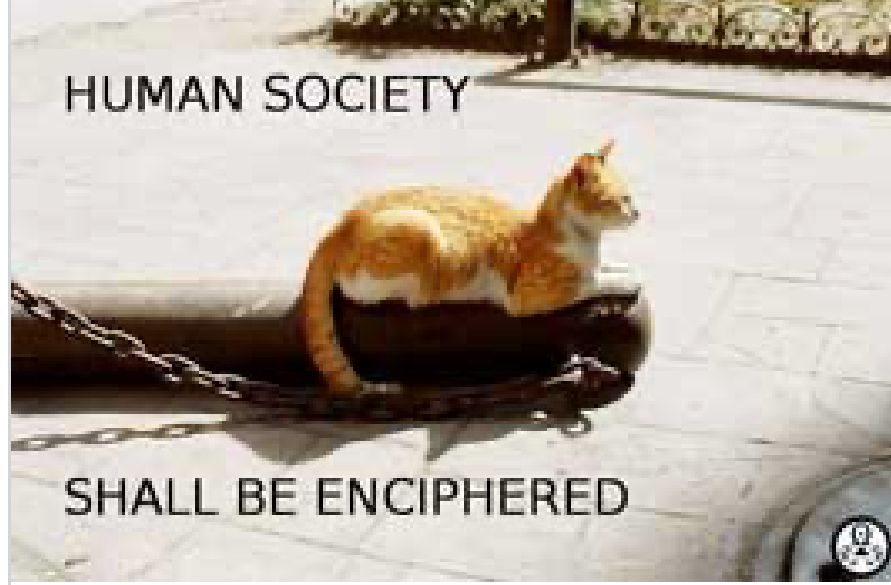
On 29 May 2016, an image of a cat was placed into an Ethereum transaction with the words HUMAN SOCIETY SHALL BE ENCIPHERED. The image was small, just 264 by 175 pixels. Its significance was not in technical complexity or visual polish, but in the decision to put an image directly into the transaction data of a network still in its early years.
The artifact would later be identified as Ethscription #0, giving it a place in the history of on-chain images that predates CryptoPunks, CryptoKitties and the widespread use of NFTs. Those later movements helped make Ethereum's cultural life visible to the public. The cat belongs to an earlier period, when the possibilities of treating transaction data as a medium for expression were less clearly defined. Its original author could not have known all the meanings subsequent readers would attach to it.
The inscription's accompanying sentence is as curious as the image. To encipher is to transform something into a form that must be decoded. Ethereum transactions already have that quality for most people: the information is public, but it often appears as hashes, addresses and hexadecimal data. The cat offers an unusually direct invitation to look through that surface. What seems like machinery can also contain language, pictures and evidence of ordinary human curiosity.
ECAT takes its name from the Enciphered Cat Archive Terminal. The cat serves as an entry point into a much larger collection, not as a claim that the history of Ethereum begins with one image. The archive brings together human-readable messages and other artifacts written into Ethereum transactions. Through search, discovery and chronology, visitors can encounter records that are easily overlooked when a blockchain is understood only as a financial ledger.
The project also has a later token chapter. The current ECAT site describes a launch through PONS on Robinhood Chain, paired with ETH, and states that the developer burned a 5% token allocation. It describes a creator-side trading-fee arrangement intended to benefit eligible holders in ETH. Those are features of the later project, distinct from the 2016 Ethereum transaction. They should not be confused with the provenance of the original image, and any current token mechanics should be checked against the relevant on-chain records.
The first cat is therefore both an artifact and a doorway. Its image belongs to a particular transaction on a particular day; the archive it inspired opens onto years of other people leaving words in the same public system. Some wrote for an audience, some for themselves, and some perhaps simply to see whether the network would remember. ECAT exists to make those traces easier to find and to keep the distinction between the original records and the stories we tell about them visible.
PROJECT REFERENCE ADDRESS
0xedca7a2d9f384bf5581cbf211de8973728dfb646
This is a project reference address, not a verified transaction hash for the original 2016 cat.